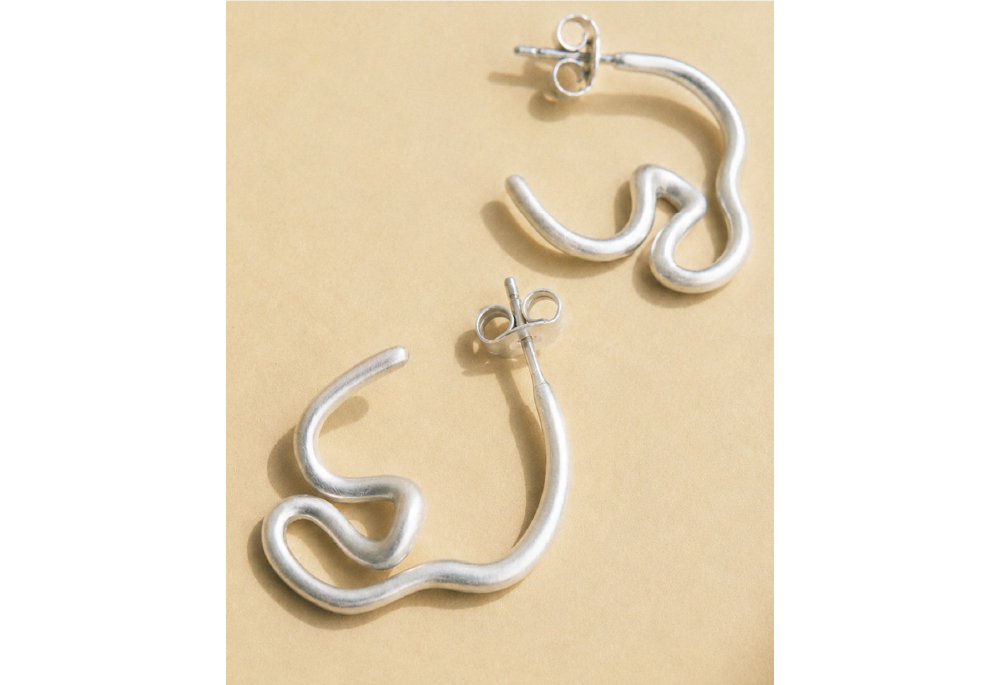
Organic jewelry finds its language where geometry stops being exact. Curves, reliefs, asymmetries, and volumes transform metal into an almost living material. Nature is present, not as an image to reproduce, but as a repertoire of rhythms, surfaces, and forms in constant transformation.
In contrast to the precision of a straight line, organic forms introduce something more intuitive: a shape that seems to have grown, eroded, or changed over time. In jewelry, this language transforms each piece into a small sculptural object that finds its final form when it comes into contact with the body.
What Defines Organic Jewelry
A dune changes with the wind; a wave never repeats exactly the same contour. That same formal freedom appears in Onaria, which observes the lines drawn across the sand, and in Sinuara, where the movement of the sea is translated into undulating metal. In these organic jewelry designs, nature is interpreted and abstracted: its rhythm matters more than its representation.
The design captures what happens in the landscape—repetition, erosion, movement—and transforms it into a language of its own.
The result is jewelry that resists being understood from a single perspective. Each piece changes depending on the angle from which it is viewed, finding an essential part of its expression in light and movement.
Texture as a Language
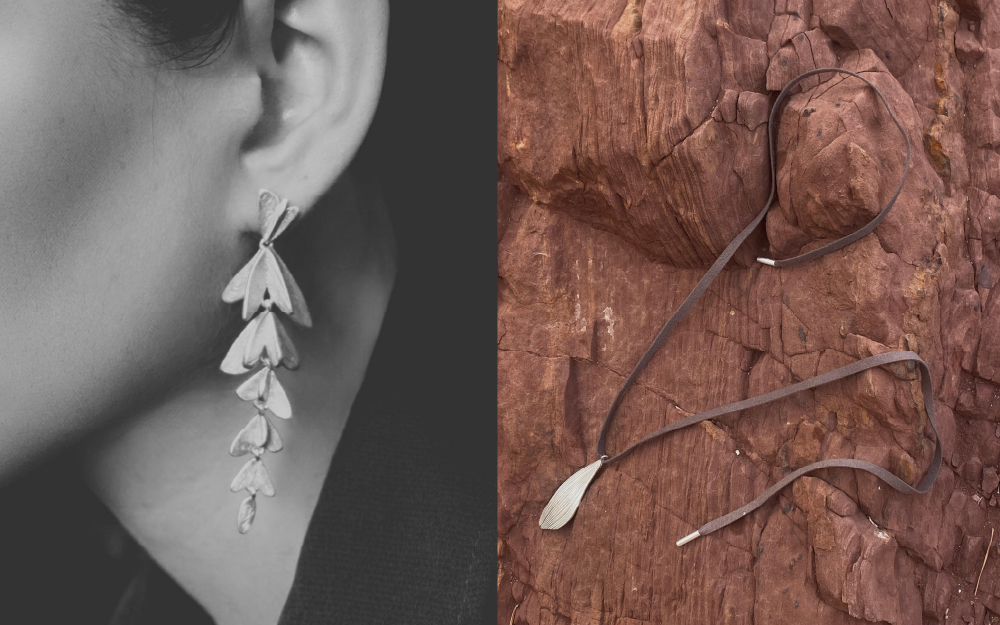
The surface of a piece of jewelry can also become a landscape. Sauma takes inspiration from the bark of the cork oak, while Lignis turns its attention to the traces and textures of wood. Their reliefs interrupt smooth surfaces, creating small irregularities where light can settle.
In Silvela, inspired by wild leaves and flowers, this relationship with material takes on a botanical character. These are pieces in which touch and sight almost become part of the same experience.
Texture adds depth even to smaller designs. An irregular surface creates shadows, reflections, and nuances that shift throughout the day. Jewelry is no longer perceived as something static, revealing new details as it is worn.
Organic Rings: Small Sculptures
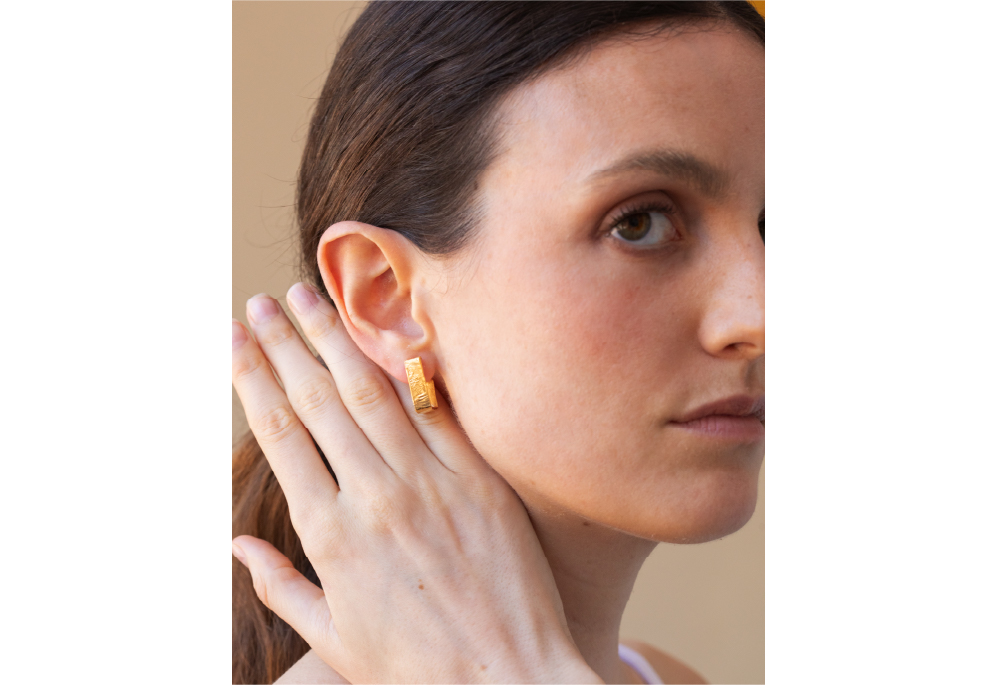
An organic-shaped ring transforms the hand into the setting for a small sculpture. Cala traces soft contours that recall the landscape of the Costa Brava, while Estrat, created with sculptor Sara Domènech, builds reliefs inspired by the geological layers of the Mediterranean landscape.
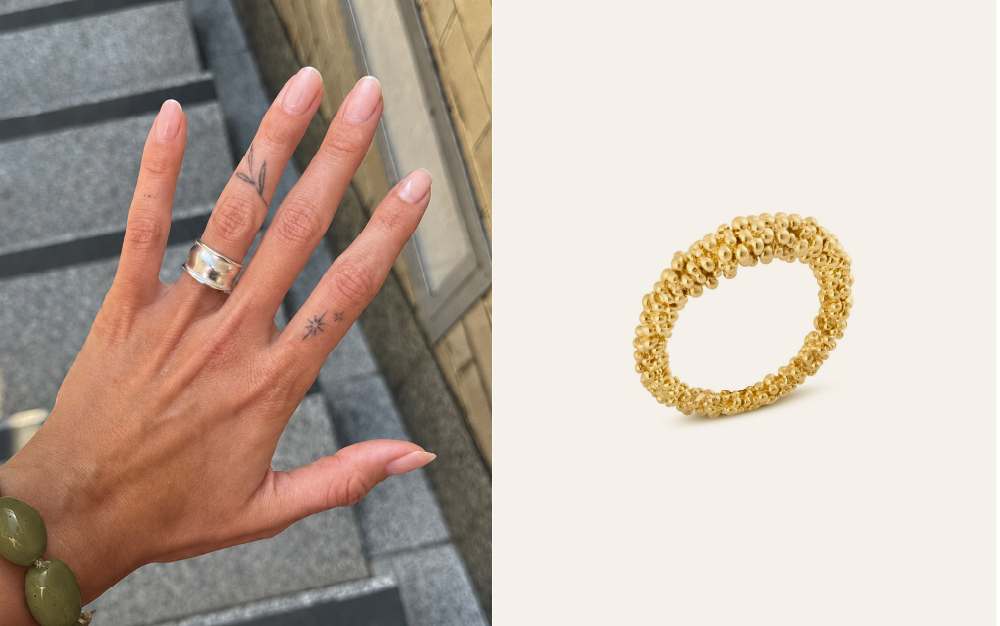
In Stardust, small spherical forms come together to create organic compositions that invite experimentation. The rings can be worn alone or combined, stacking several pieces in the same finish or mixing gold and silver for a freer, more personal composition.
In these textured rings, the form does not end with the object itself: it continues across the fingers, through the light, and in every movement of the hand.
Organic Earrings: Form and Movement
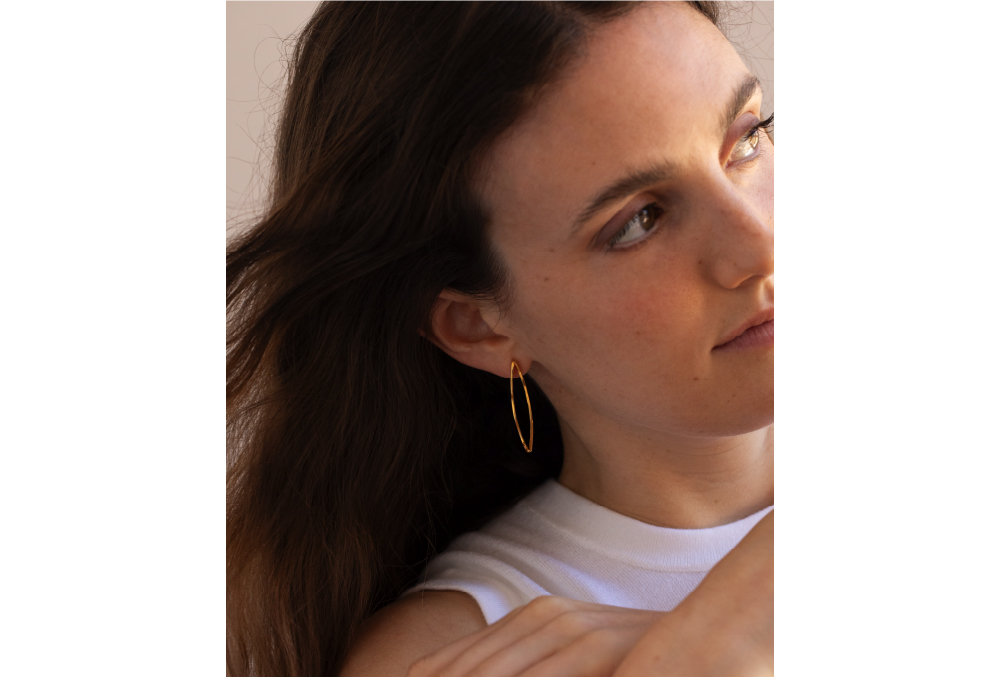
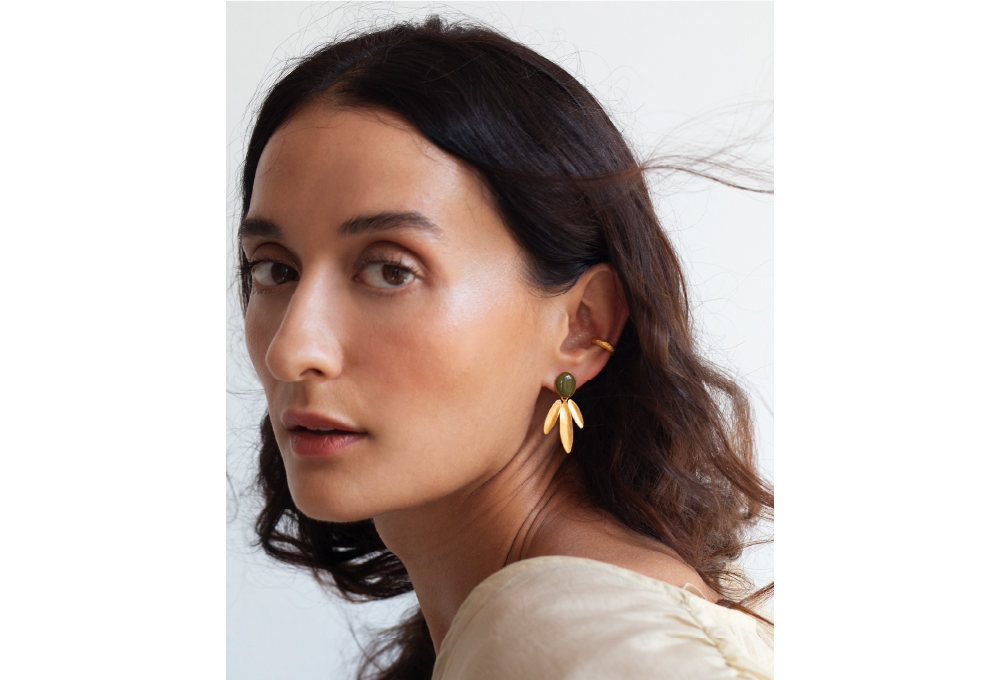
In organic-shaped earrings, movement becomes part of the design. Olivia explores contemporary volumes, while Pampalonia takes the wild Mallorcan peony into a more sculptural territory, somewhere between a recognizable flower and abstraction.
Deliri, created with artist Àfrica Fanlo, also introduces color as a pictorial gesture. Enamel is no longer simply a finish; it becomes part of the composition, like a brushstroke across metal.
Placed close to the face, these forms take on a particularly expressive dimension. The profile changes, volumes cast new shadows, and movement means that the piece is never perceived in exactly the same way.
The earring thus becomes more than an ornamental element: it becomes a moving form in constant dialogue with the person wearing it.
Necklaces and Bracelets: Lines Across the Body
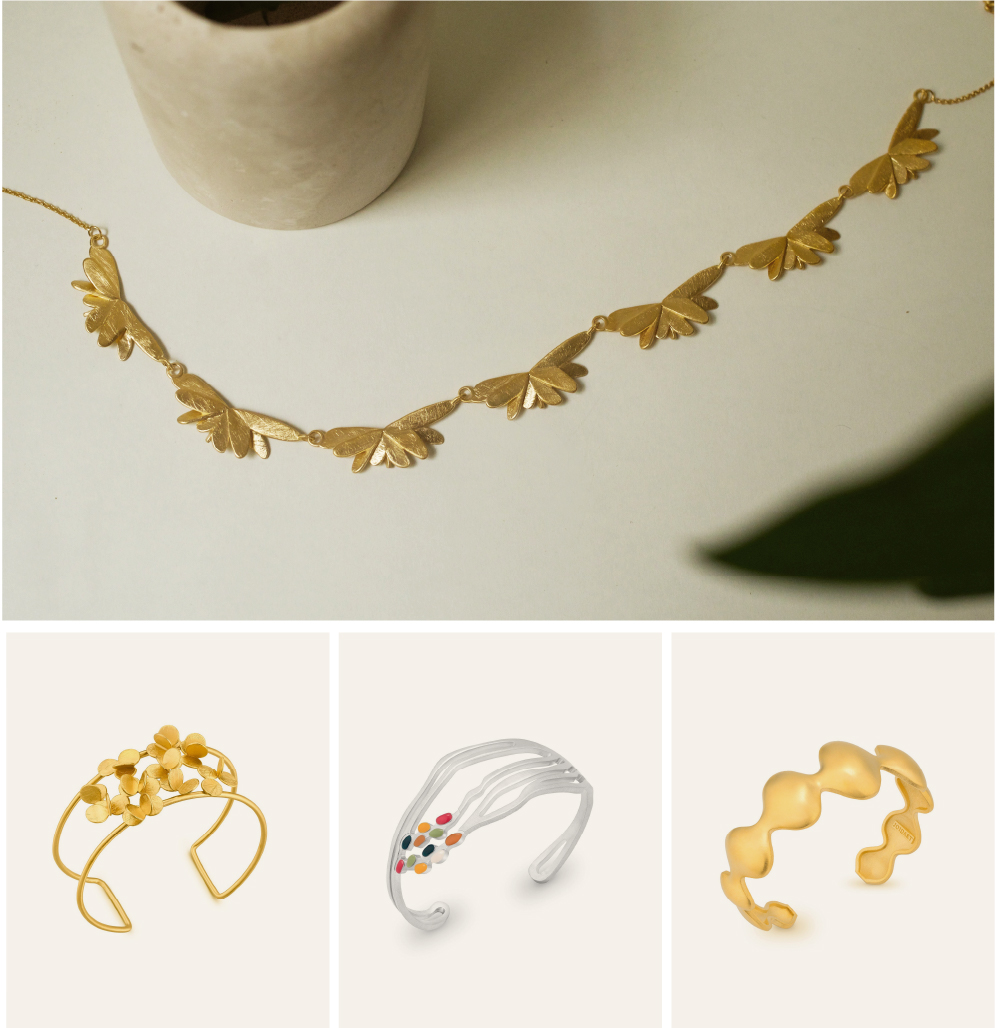
A piece of jewelry can also be understood through the space it draws. The Vol necklace explores volume through lightness, creating forms that seem to contain air. The Arai bracelet, meanwhile, begins with the repetition of the circle: an essential form that, when multiplied, creates rhythm and volume.
In necklaces and bracelets, these structures do more than simply occupy the body. They interact with it, alter its silhouette, and take on new interpretations through movement.
Negative space also becomes part of the composition. The spaces between forms allow the skin to appear, visually lightening even pieces with a stronger presence. Metal, body, and negative space ultimately become part of the same image.
It is precisely this relationship that brings jewelry closer to the language of sculpture: what matters is not only the material itself, but also the space that surrounds it.
The Beauty of Irregularity
Surrealism and Gaudí’s architecture took this fascination with changing forms into different territories. In the Dalí, Jewelry by Joidart Swans earrings, nature enters the visual transformations so characteristic of Dalí’s universe. In the Gaudí Jewelry Fruits necklace, inspired by Casa Batlló, organic forms emerge from Gaudí’s way of looking at nature. Its curves and volumes translate into metal a language in which architecture and the natural world seem to belong to the same living organism.
Both universes remind us that nature has been much more than a source of decorative motifs throughout history. It has also offered a way to question established forms and imagine new ways of building, creating, and seeing.
From bark to dunes, from flowers to the sea, organic jewelry begins by observing what rarely remains still. Irregularity is not an accident but part of the language: an open form that light, the body, and gesture ultimately complete.