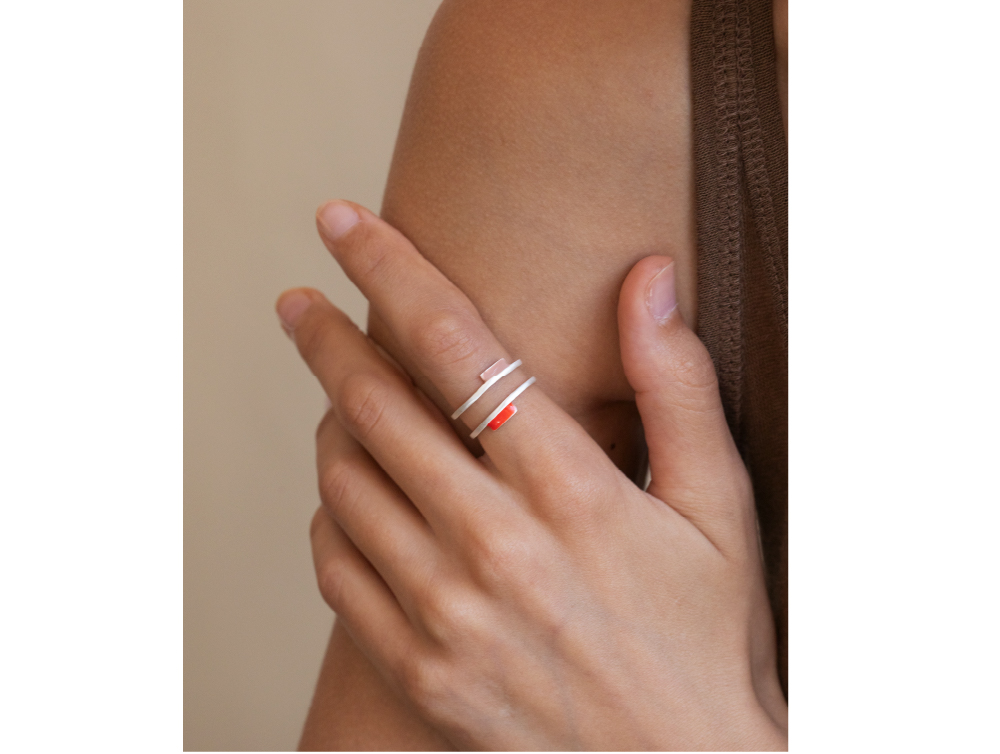
Choosing among the best ring designs is not about finding a universal formula. A ring can stand out for its volume, an unexpected texture, its color, or the story behind its form. But it can also captivate us for something harder to define: the way it interacts with the hand and eventually becomes part of our gestures.
Because of its scale and closeness to the body, a ring has something of a small sculpture. It can be observed from different angles, changes with movement, and allows for experimentation with forms ranging from essential geometry to organic volumes and compositions filled with color.
Organic Forms: Designing Beyond Perfect Geometry
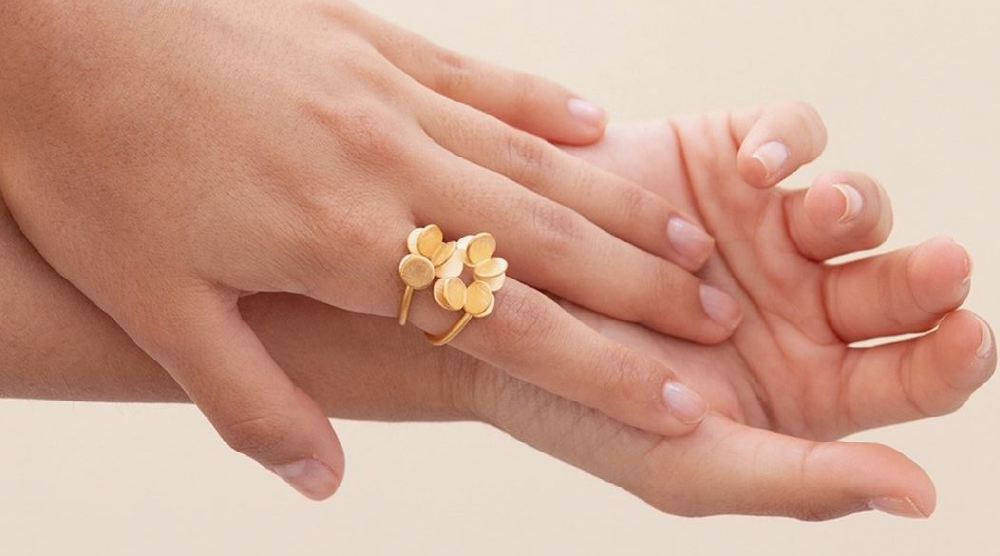
Not every form needs to follow exact symmetry. Curves, irregularities, and lines that seem to transform introduce a more intuitive way of constructing a piece of jewelry.
Cala traces soft contours that recall the landscape of the Costa Brava. Pampalonia takes inspiration from the wild Mallorcan peony, transforming its floral structure into a sculptural form somewhere between recognition and abstraction. In Silvela, wild leaves and flowers inspire forms and textures that translate a botanical language into metal.
Nature appears here as a starting point, but not as something to be reproduced literally. What matters is interpreting its rhythms, movements, and structures to discover new forms.
In these ring designs, irregularity allows the piece to change depending on the angle from which it is viewed. Light, the movement of the fingers, and the anatomy of the hand itself complete the composition.
Texture Is Also Part of the Design
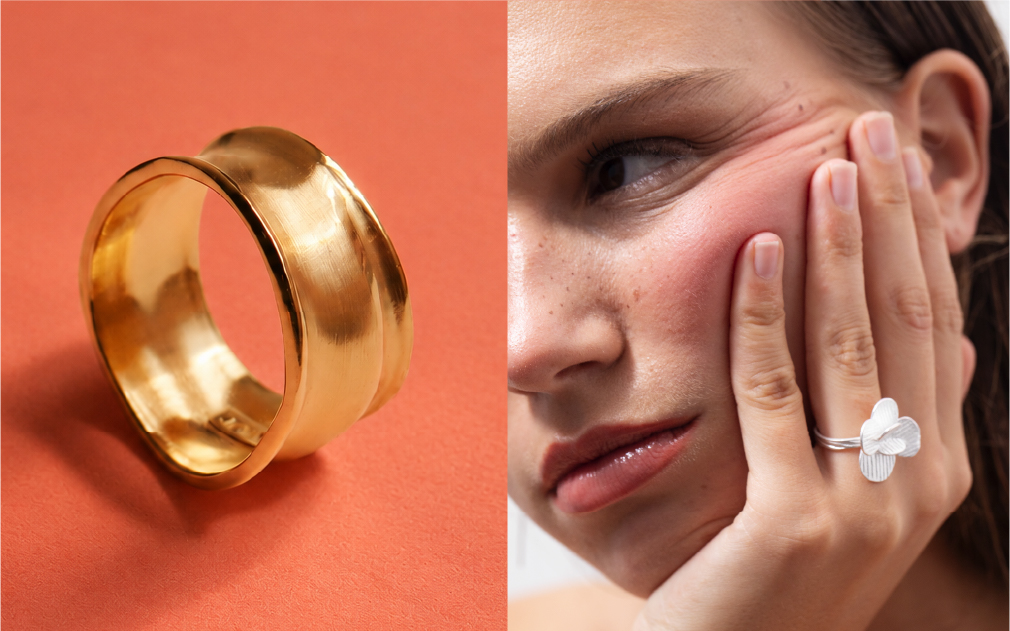
Sometimes, the character of a ring lies not in its size but in its surface. Relief can alter the way light falls on metal, allowing a piece to reveal new nuances as it moves.
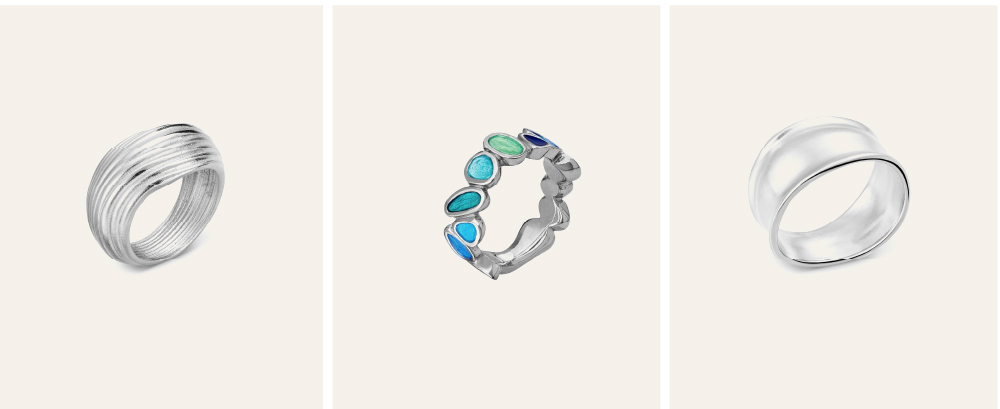
Onaria transforms the lines drawn across dunes by the wind into a surface of sinuous forms. The relief adds depth and allows light to travel across the ring differently with every movement of the hand.
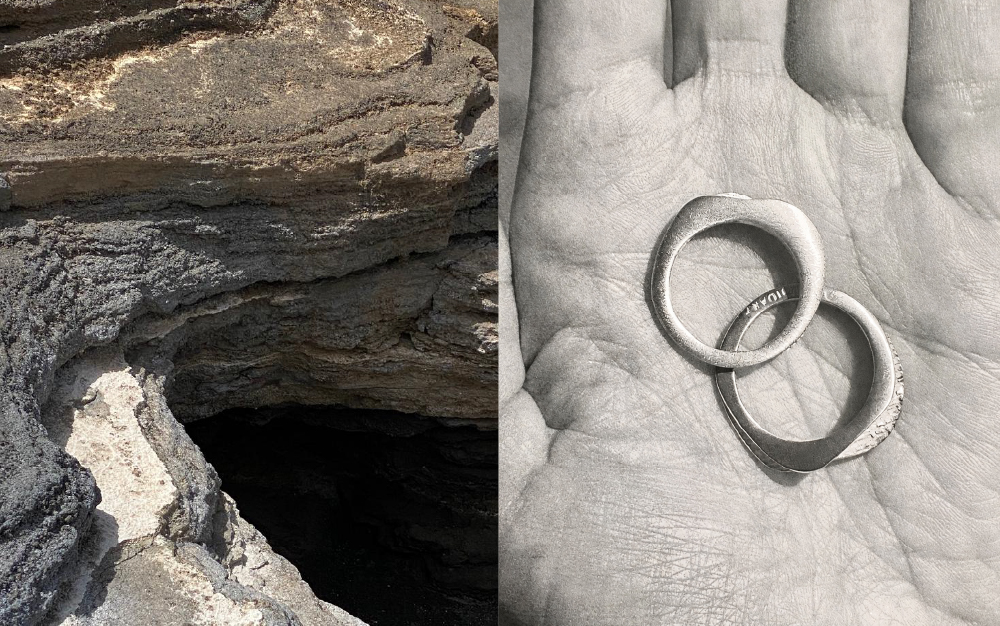
In Estrat, created in collaboration with sculptor Sara Domènech, matter takes on an almost geological dimension. Its reliefs are inspired by the layers and fractures of the landscape of the Terres de l’Ebre, translating this observation into a sculptural surface.
In these textured rings, the surface is no longer simply a finish. It becomes a language. Light finds small irregularities where it can settle, and the jewelry changes visually with every gesture.
Color as Part of the Composition
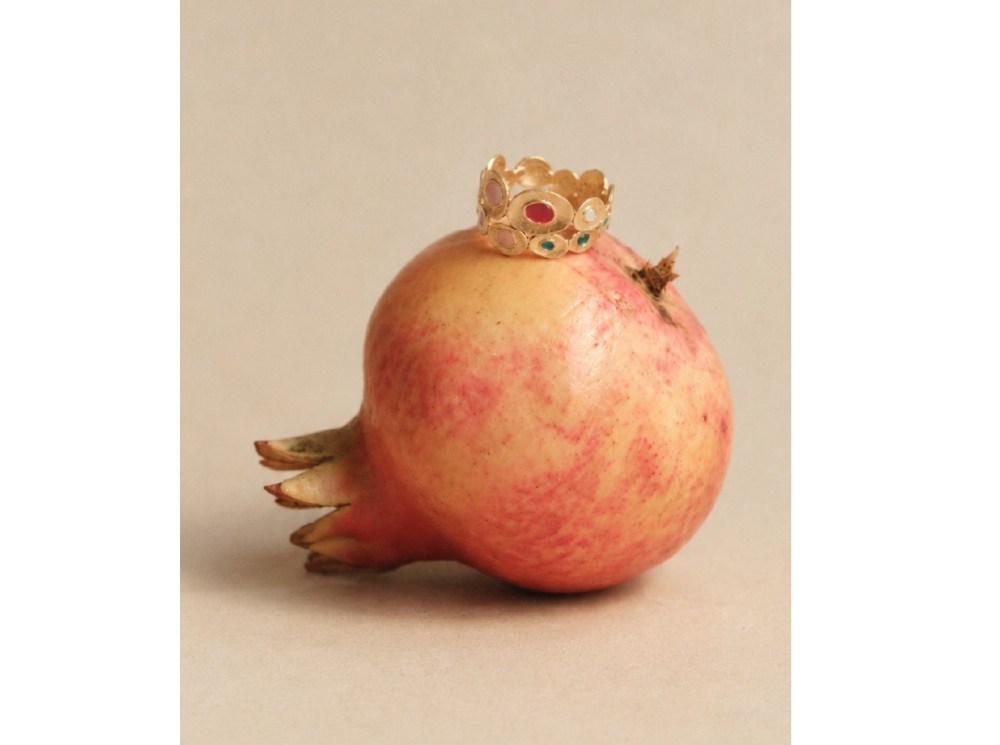
Color can completely transform the perception of a form. It can draw the eye toward a small detail, create contrast, or become the element around which the entire piece is constructed.In Deliri, created with artist Àfrica Fanlo, enamel participates in the composition almost like a pictorial gesture. Color is not simply decorative: it interacts with the metal and becomes part of the jewelry’s identity.
Tremelia follows a different logic. Inspired by the idea of a deconstructed mosaic, it combines repetition, geometry, and enamels in different colors. Forms follow one another, creating a visual rhythm that changes depending on how the piece is viewed.
These pieces show that the best ring designs can also be found in color’s ability to transform a structure and give it an entirely different reading.
Rings Inspired by Art and Architecture
A painting, a sculpture, or a building can become the starting point for a piece of jewelry. The challenge is not necessarily to reproduce it, but to understand its language and translate it into another scale.
In Miró Jewelry, the forms and compositions of Joan Miró’s universe take on a new dimension when translated onto the body. The ring is no longer a representation of the artwork but becomes a different way of connecting with it.
In Gaudí Jewelry, architecture offers another repertoire of possibilities. Curves, geometries, color, and structures inspired by nature allow architectural elements to be transformed into forms designed for the hand.
The universe of Dalí, Jewelry by Joidart also explores this relationship between art and jewelry. Dalí’s Surrealist imagery often begins with recognizable forms that transform, shift in meaning, or invite us to take a second look.
In these cases, the value of the design lies not only in its final form. It can also be found in the story it carries and in its ability to translate an artistic language into an intimate scale.
A Composition of Your Own: Wearing, Combining, Choosing
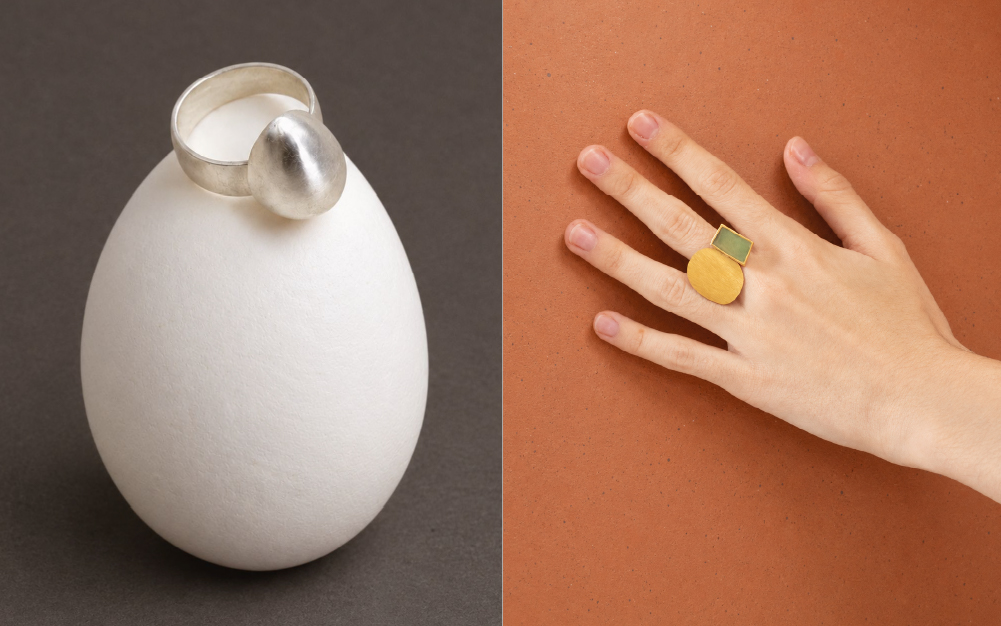
There is no single way to wear a ring. The same piece can take on a different presence depending on its position, the combinations that surround it, or even the way it is oriented on the hand.
Interval, created in collaboration with graphic artist Judit Canela and inspired by Barcelona’s hydraulic tiles, takes this idea into the design itself. The ring can be rotated to reveal different forms and colors, creating different compositions from a single piece. A small gesture changes its appearance, allowing it to adapt to your style, the moment, or simply how you feel like wearing it that day.
Interval’s geometry thus becomes anything but static. Like the hydraulic mosaics that inspire the collection, the same structure can generate different interpretations depending on how it is arranged and from where it is viewed.
Stardust proposes another form of personalization. Its small spherical forms come together in organic compositions, and its rings can be worn alone or stacked. Combining several pieces in the same finish creates continuity, while mixing gold and silver introduces contrast.
These are two different ways of creating a personal composition: Interval transforms perception within a single piece; Stardust does so through combination.
Choosing between different rings also means considering the relationship we want to establish with them. A larger design can become the focal point, while several smaller pieces can create a composition together. There is no single formula: proportion, balance, and experimentation are all part of the process.
Among the best ring designs, perhaps the most interesting are those that continue to capture our attention after we have worn them many times. Pieces whose form, texture, volume, or color carries an intention and finds a different way to express itself on the body.
Because design ultimately finds its meaning when it is worn: on the hand, through movement, and in the personal way we make a piece of jewelry our own.